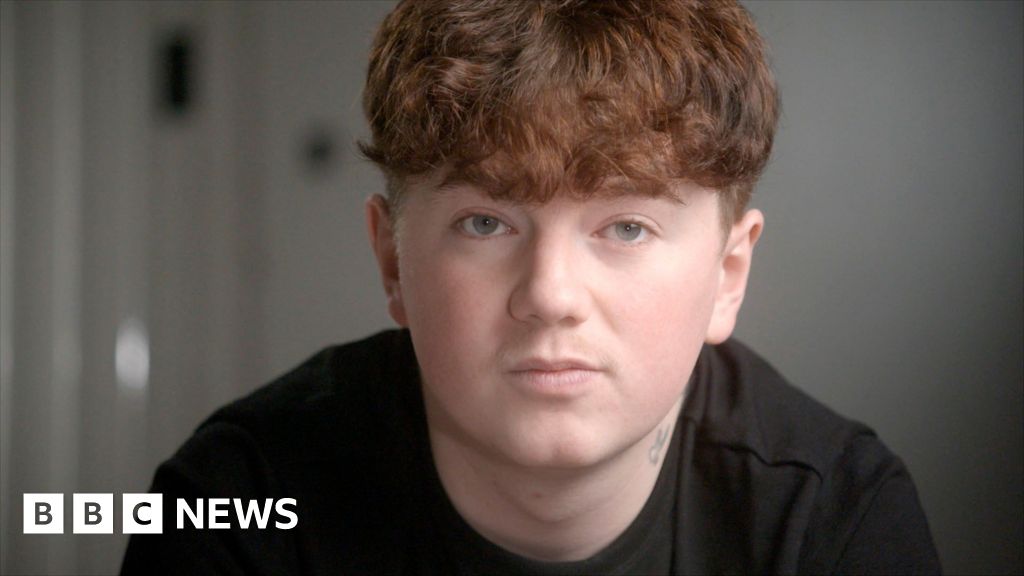
Alex Batty, who was abducted as a child and taken to live abroad by his mother, has contacted her for the first time since his return to the UK in 2023.
Alex, from Oldham, was declared missing by his grandmother in 2017, aged 11, after his mother and grandfather abducted him while on holiday in Spain, before moving to France.
His mother, Melanie, who was not his legal guardian and was heavily influenced by conspiracy theories, told him to throw away his passport. They then lived part of the time off-grid, and he did not attend school.
In a new BBC documentary, Alex, now 20, retraced his years in isolation, which at one point saw him living in a tent, sometimes eating just one meal a day and carrying out manual labour for money.
By taking part in the documentary, he hoped to understand more about his mother and why she did what she did.
"My relationship with my mum, it's such a complicated thing," he told the BBC in his most in-depth interview since fleeing his mother. "I'm annoyed at what she did… the experiences I missed out on and my lack of education."
As part of the BBC Three documentary, now available on iPlayer, he also spoke to people they met in small towns and villages across Spain and France, saying it "opened up my eyes".
Reliving his teenage years brought up conflicting emotions for Alex. He learned more about his mother, but on learning how others perceived their situation, he worried it could "villainise" her.
Alex, who recently started a family of his own after becoming a father to a baby girl, said the experience of making the documentary led him to reach out to his mother again.
But the journey was not easy: Alex confronted people he met while missing about why they did not contact services to help him. He also learned that some people did alert authorities in France – but that help never came.
Alex was just a child when Melanie became engrossed in the "sovereign citizen" movement, which holds governments worldwide to be illegitimate. Followers believe they can opt out of laws and practices they do not agree with, such as paying mortgages.
This led to their family home being repossessed when Alex was eight and Melanie selling all her belongings to live with like-minded people in Morocco.
They returned six months later when they ran out of money and it was then that Alex moved in with his grandmother Susan, who was given legal responsibility for him despite Melanie's disapproval of not being his legal guardian. When Susan reluctantly let Melanie take him on holiday to Marbella in September 2017, he never returned.
Susan contacted the police in the UK and a widespread media appeal was launched, but Alex, Melanie and David could not be found.
For the documentary, Alex visited the small town of Benifairó de les Valls, north of Valencia, where they hid for two months.
To avoid being found, Alex recalls he wore hats and glasses, grew out his hair and stayed indoors most of the time as news of his disappearance spread.
He said he found it "really cool" at first and felt like "James Bond". But Melanie and David stressed to him that the situation was serious.
"What they used to say is that under the law it's classified as kidnapping but it isn't kidnapping because she's my mum," he said.
After a couple of months, they went to a mountainous village south of Valencia called Villalonga to live with a woman called Trixie. She provided room and board in return for manual labour and help around the house.
Revisiting, Alex wanted to find out "what my mum was looking for and why such drastic measures were necessary".
Trixie said she understood why Melanie had thought that living outside of regular society would make for a happier and healthier childhood.
"She wanted for you to see the world a better way than sitting at school," Trixie told Alex. "You were running wild, of course you were – 12, 13 years old. Climbing trees, walking dogs, swimming in the river – you had a real life."
When asked why she didn't contact authorities after she saw the media coverage, she said: "I honestly felt that it was none of my business. I never got the feeling you were here against your will."
Alex understands that Trixie and his mother were likeminded and she only ever saw him "happy, healthy, learning".
"Most of them believed that life experience was better than school," he said.
After staying with Trixie for about two years, they moved into a flat in the middle of Villalonga as Alex started to feel lonely.
"We used to sit at a cafe quite often and the school was right next to it," he recalled. "I'd hear the school bell ring, the kids would come out of school and it really made me miss it. I walked up to my mum and I cried my eyes out because you know, I'd had enough."
Then it was on to France, with Melanie's goal of finding them a permanent community.
Alex describes moving around from place to place as "tiring" and "repetitive". "I wanted to have some permanence," he said.
Alex worked to help support his mother. "I was made to work at 14 and she was perfectly healthy to work. And she never did," he said.
He recalled that his mother was so engrossed in her spiritual work that he needed to earn money to pay for her rent and get food for the family.
Melanie never took a break from her work, Alex said, adding: "It's not normal is it? You know it messes with people's heads quite a bit."
Then aged 15, he moved to a campsite in Belesta in the Pyrenees, south-western France, but without as much work in the local area, he said he got by with just one simple meal of pasta and sauce on its own for some time.
After a period of tension due to Alex challenging Melanie's theories, she did not allow him to live in her caravan and he was forced to spend six months sleeping in a tent.
"It was winter time – raining, it was wet, it was cold all the time. And my mum was living in this campervan with heating, water and electric – [yet she] would rather me sleep outside in a tent."
Alex did not know at the time, but the young daughter of the campsite's owner saw the conditions in which he was suffering and contacted French social services.
Speaking to Alex in the documentary, she told him: "I thought it was a bit of abuse. I thought she was really not a responsible mum.
"I called social services except they told me that you were a foreigner and that I did not have your true identity, they couldn't do anything."
Learning about this missed opportunity for the first time is hard for Alex to stomach.
"I'm so mad, so mad that no one did anything," he said. Realising he would have been able to go back to school if he was rescued made him feel "very angry".
French social services told the BBC they could not comment on individual cases.
But this was not the only missed opportunity. Alex tried to sign up to a computer college in France and told them his real name. The college informed the police.
Two officers were sent to the address Alex was working at under the guise they were looking for a missing car.
"I thought they'd come to take me away and honestly I was nervous but mostly I was relieved," he said.
When they revealed they were only looking for a stolen car he was "devastated".
"I could have said something there and then but I didn't because protecting my mum and grandad, them not going to prison, was at the forefront of my mind," he added.
The National Police were contacted for comment by the BBC but did not respond.
With Alex becoming increasingly unhappy, six years after being abducted, he had had enough. He wrote a goodbye note and left the small commune in the Pyrenees in the dead of night.
But to protect his mother and grandfather from the police and possible arrest, Alex said he walked through hills and forests for days to make it harder from anyone to establish where he had started from.
"After a couple of days I decided to finally hitchhike and I got in this guy's van."
He was taken to police in Toulouse, before being brought t
📰 மூல செய்தி (Source): https://www.bbc.com/news/articles/cjepwven131o?at_medium=RSS&at_campaign=rss












 உலகம்9 years ago